Career starters were finding Tallo through Google, landing on a job listing, reading it, and leaving. It was the same listing they could find on Indeed, so nothing gave them a reason to stay. Tallo wanted to be genuinely useful to people in their late teens and early twenties heading into work without a college degree, and I led product development for that audience.
I wrote about this work as a case study on Fieldway, too. Read the Fieldway version on fieldway.org.
Narrowing a Feature List to One User Question
The research from the earlier strategy work surfaced 15 problems Career Starters face. When we sat down to design, a long list of feature ideas was competing for the first slot, and we cut it down to one problem, stated the way a user would say it: "I need to know what jobs are worth applying to." The second problem on the list – what should my next step be – became the next thing we built.
Narrowing to one question gave design, engineering, and data a shared test for every idea that came up afterward. Does this help someone decide whether a job is worth their time? If not, it waited.
Designing for an Audience That Distrusts Guidance
This audience made the design constraints unusual. They research careers on TikTok and Reddit until the volume overwhelms them, and they're more likely than older generations to fall for job scams, so many treat all guidance with suspicion, including the good kind. A score they couldn't believe would be worse than no score at all.
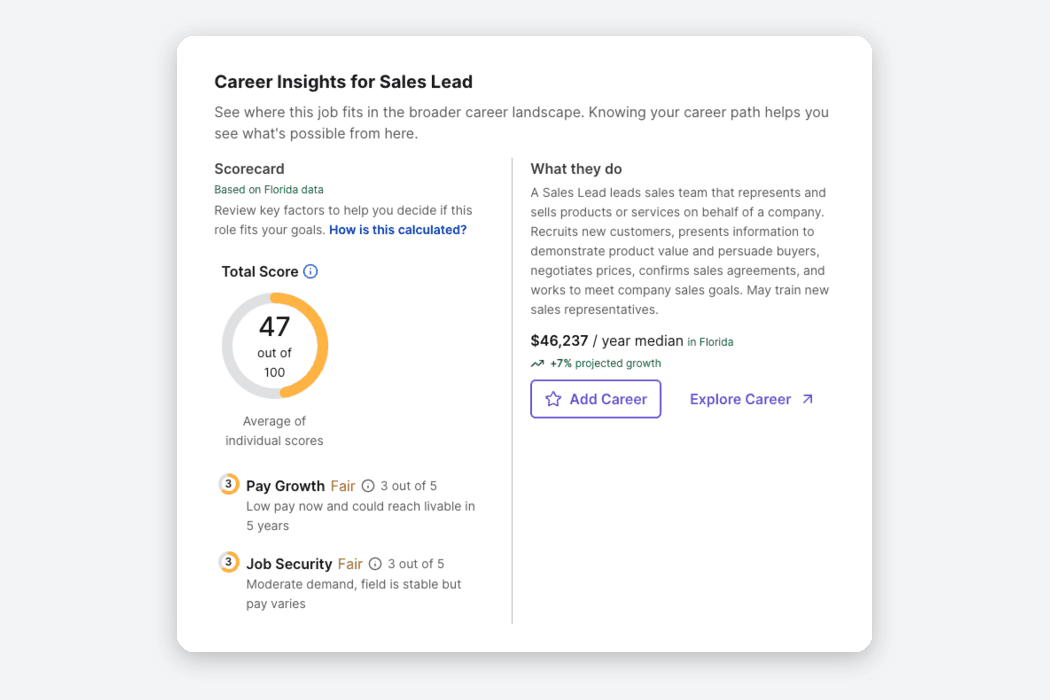
So the first Job Scorecard shipped with two scores, pay growth and job security, each with a plain-language read ("Moderate demand, field is stable but pay varies") and a link explaining exactly how it's calculated. The tone mattered as much as the math. An anxious 19-year-old doesn't need a list of everything they're missing, so the scorecard is written to help them weigh a decision, not to grade them.
Letting the Data Set the Level of the Score
As we watched people use it, the scorecard moved up a level. The Job Scorecard became the Career Scorecard, rating the career a job belongs to, because that's where the underlying data is strongest. It now sits next to what people in that career actually do, median pay in the learner's state, and projected growth, with buttons to add the career as a goal or explore it in depth.
A score that claims more precision than its data has is a trust problem waiting to happen, and this audience would have found it. Rating the career kept the scorecard accurate, and it gave learners a next step – a single job listing became a doorway into a whole career.
Grounding Recommendations in Real Career Moves
Once someone can tell a job isn't worth it, they need an alternative. Rather than guessing, Tallo partnered with Opportunity@Work, whose Skills Mobility Data Model maps the moves millions of U.S. workers have actually made, including workers Skilled Through Alternative Routes (STARs) who look a lot like Tallo's audience. On a job page, the recommendations show nearby jobs that call for similar skills and score higher on pay growth and job security, along with how much more each one pays.
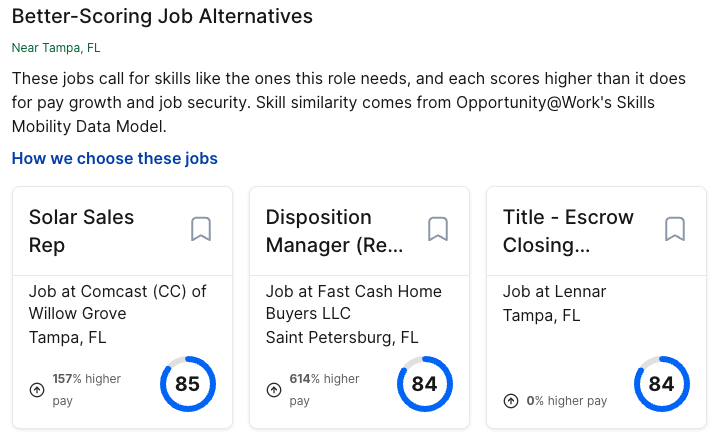
The dependency between the features was deliberate. The scorecard defines what "better" means, and the recommendations use that same definition, so the product tells the learner one consistent story instead of two competing ones.
What Iterating on Recommendations Taught Me
The first version of the recommendations didn't perform the way we'd hoped, which is common for recommendation features. Working through why sharpened how I think about them:
- People judge relevance in a glance. If the first card looks wrong, the rest never get a look, and the quality behind the click doesn't matter.
- "Better" has to be concrete. A raise someone can see beats a score they're asked to trust.
- Reachability matters as much as upside. A dream job two degrees away isn't a next step.
- Transparency pages are necessary, not sufficient. Few people read the methodology. They trust what looks right.
Building for Skeptical Users
The pattern I'd carry to any product with a skeptical audience is to let the user's own question pick the first feature, and then let the data decide how precise a claim you're allowed to make. Design around the claim you can defend, not the one you wish you could make. And when features build on each other, have them share definitions, so the product never contradicts itself.
Most career starters are closer to a better job than they think. Good product work helps them see the step in front of them.
FAQ: Building Career Guidance Products
How do you choose the first feature for a new audience?
Start from research into the audience's real problems, then pick the one they'd name themselves. At Tallo, that was "I need to know what jobs are worth applying to." A single question in the user's own words gives every discipline a shared test for whether an idea belongs in the first release.
Why did the Job Scorecard become a Career Scorecard?
The underlying pay and growth data is most reliable at the career level, so rating the career kept the score accurate. It also gave learners a natural next step: exploring the career itself, not just the one job in front of them.
How do you build job recommendations people trust?
Ground them in evidence, like the career moves real workers have made. Make them specific about why a job is better, keep them reachable from where the person is now, and make relevance obvious at a glance. Methodology pages support trust, but they don't create it.
Related Case Studies
- Rescuing a Stalled 80-Person Product Team at Stride – my earlier work with Tallo's parent company, where I also led the technical and feature discovery for the Tallo acquisition.
- Enterprise Agile Transformation Piloted for 20,000 Consultants at a Big Four Firm – another engagement built on diagnosing what a large organization actually needed.