I went into my first newsletter meeting with Aaron Scott expecting to write a couple of emails, maybe three. By our second meeting he'd put together a full engagement calendar for the year, with 24 sends on it – 15 to members and 9 to prospective members – and I was reading it on the call, asking, "Am I reading this right that I'm writing all of these?"
I was. So I built a system that turns a recorded Generosity Collective event into two newsletters, one for members and one for people thinking about joining, and hands each one to CFO ready to send. Eight issues have gone out since June. The first one was on my task list at three hours, and most of them since have been on it at fifteen minutes.
Generosity Collective is a giving circle at the Community Foundation of the Ozarks. Members each give $2,500 a year, pool it, spend the year learning about the community's needs from the people working on them, and then vote on where the grants go. I've been a member since the first year, and I'm on its advisory board and membership committee. All of this was volunteer work.
The Problem
Membership was sliding. Generosity Collective started with 64 or 65 members, had 47 in its second year, and by February 2026 had 34 committed for the year. When the board looked at why people didn't renew, time was the first reason on the list: members felt unable to give it the time they thought it required.
Prospective members said much the same thing from the other side. Some told us they didn't feel comfortable joining because they couldn't come to all the events, and they didn't want to cast an uninformed vote. As I said to Aaron at the time, "that's fixable."
The other half of the problem was at CFO. Generosity Collective is run by Foundation staff who have plenty else to do, and when Aaron and I first talked, he was clear that he wasn't looking to hand everything to me – he wanted to "shift some stuff off of" the plate of the staff member who runs it day to day, who was "very busy managing all this stuff." By our second call he was weighing whether the person who handles CFO's email could take on more. "I sort of hesitate to add, like, another couple of regular emails to his plate," he said.
In February I'd suggested we stop leaning on attendance. Make the events more optional, record them, and send summaries, so members could stay informed and vote well even if they missed a meeting. The newsletter is that idea, built.
The Recruitment Sequence
Before the newsletter, there was a recruitment push. In February the board set out to rebuild membership ahead of the March 4 kickoff event, and every board member was asked to reach out to people they knew.
My part was a six-email sequence to 29 prospects, sent between February 17 and March 9. Each email told a different story about a grant Generosity Collective had already made, and each one aimed at one of two things: reply to me, or come to the kickoff. The $2,500 was stated plainly, but the emails led with what membership turns you into rather than what it costs. The line I kept coming back to was, "You stop being someone who donates and start being someone who decides." Every email left an easy way out, too: "if you ever want me to stop emailing, just say the word."
I ran the sequence out of the relationship-tracking tool I built for my consulting work, which handled the scheduling and kept track of who'd replied. The stories, and nearly all of the writing, were mine.
The day after the last email, one prospect wrote back, "I am impressed and will join the organization." By June, Generosity Collective had 51 members, 17 of them new, and $127,500 in contributions for the year. That was a board-wide effort, with members reaching out to their own networks and CFO doing outreach of its own, and the sequence was my share of it.
Building the Newsletter System
What I pitched to Aaron in April was simple: I'm at every event anyway, so I'll write up what happened and send it out. On a call in May we turned his calendar into a process, and he made two calls that shaped everything after.
The first was sending through Mailchimp instead of from my email. I'd recommended it so people could unsubscribe cleanly and have it sync to CFO's list, and Aaron added the reason that mattered more: "a post Matthew Stublefield Generosity Collective environment." He didn't want GenCo depending on me – "hit by a bus" was the phrase – and he was right. The second was keeping CFO's side to a copy and paste. I'd hand over a finished draft; CFO would review it and send it.
So here's how an issue gets made:
- Granola records the event on my iPad.
- Claude reads the full transcript, along with the last couple of issues so the same story doesn't run twice in a row, and drafts a members version and a prospective version.
- I edit both in Obsidian, where my notes live. Nothing moves until I mark it approved.
- Approval publishes a Google Doc into a Drive folder CFO shares with me, and emails Aaron that it's ready for review.
- CFO puts it into Mailchimp and sends it.
The drafting runs on the same voice rules I use for everything I write, with a layer for community writing: thank people plainly, keep every email to one job, and give every ask an easy out. On the members side that looks like, "To do today: put September 17 on your calendar so you can attend!" followed right away by "But no worries if you can't make it – we'll send out a recap afterwards."
Not everything worked the first time. Formatting that looked fine in my notes reached Aaron looking broken, so I added a step that renders a review copy to my own Drive and opens it before anything goes to CFO.
The first real test was the June 11 expert panel, a breakfast with four people working on homelessness, housing, career readiness, and early childhood in Springfield. Both recaps were in Aaron's hands that same afternoon.
Same Event, Two Audiences
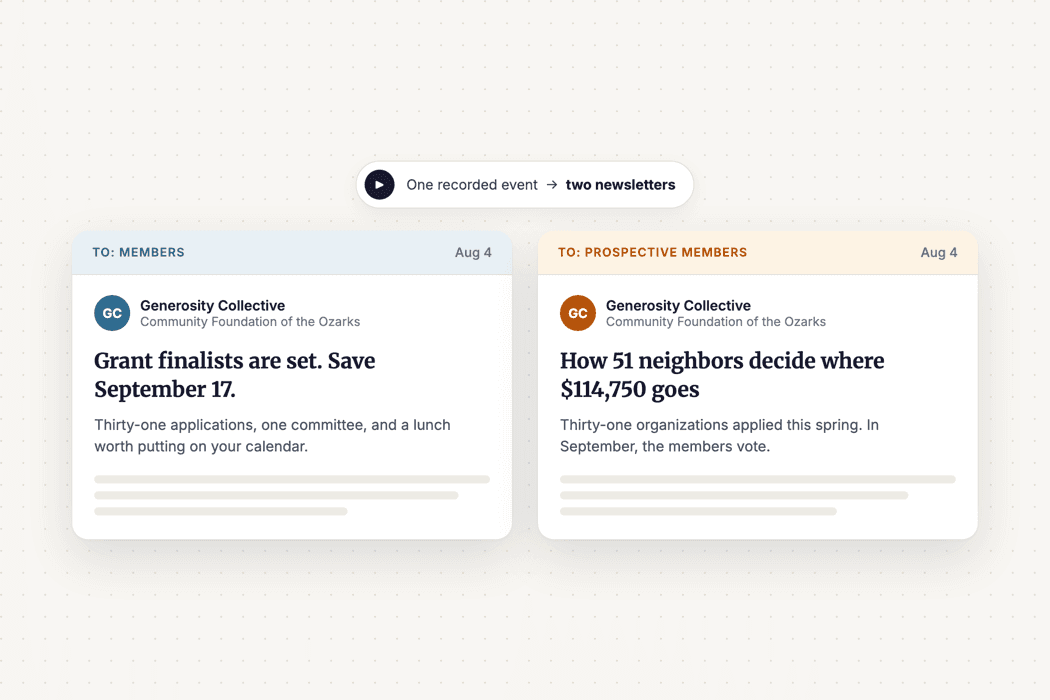
Members and prospective members need different things from the same morning. Members are going to vote in the fall, so their version of the June panel recap ran about a thousand words, with a section for each speaker and what it meant for the grants we'd be weighing. It opened, "If you couldn't make it, here's what stayed with me, and why it matters for the decision you'll make in the fall."
The prospective version covered the same panel in one paragraph and spent the rest explaining what a year inside the group looks like. It opened, "You're getting this because you've shown some interest in the Generosity Collective… No pressure to join. I just want you to see what a year inside it looks like."
The subject lines show the split most clearly. The same week in August, members got "Grant finalists are set. Save September 17." Prospective members got "How 51 neighbors decide where $114,750 goes." In September, members got "Voting is open. Cast yours by October 8," while prospective members got "Members are voting. Here's how we got here."
The members version can say "we" and mean it, and can close with "We picked the areas back in March. Now we pick the work." The prospective version closes with an invitation that doesn't push: "Giving alongside fifty other people who all had to agree on it is a different thing, and I think it's worth trying once."
Results
Eight issues delivered, each before its send date. From the June 11 panel recaps through the October voting reminder, every issue reached Aaron ahead of the date it was scheduled to go out. Two were dropped on purpose, because the July coffee social didn't produce anything worth recapping.
A fraction of the time. The first issue was on my task list at three hours. Most since have been fifteen minutes, because the transcript, the drafts, the Google Doc, and the handoff to Aaron all happen without me assembling them.
It became part of how GenCo runs. The newsletter has been a standing item on the advisory board agenda since June, and by August it sat under the membership committee's outreach.
Membership recovered. From 34 committed in February to 51 for the year, with 17 new members – a board-wide push that the recruitment sequence was one part of.
CFO stays in control. Aaron reviews every issue, CFO sends it, and unsubscribes sync to the Foundation's own list.
What I'd Tell Another Small Nonprofit
Start with what's actually keeping people away. For Generosity Collective it wasn't the $2,500 or a lack of interest – it was time, and a sense that you couldn't participate properly without showing up to everything. A newsletter fixes that in a way a better event can't, because it reaches the members who couldn't come.
Build it so it outlasts you. Aaron's "post Matthew Stublefield" point is the right test for any volunteer-built system. The drafts live in CFO's Drive, the list lives in CFO's Mailchimp, and the sending is CFO's. If I stepped away tomorrow, the calendar and the past issues would still be sitting there for someone else to pick up.
And write for each audience separately. A second version used to mean twice the work, so most small organizations send one email and hope it fits everyone. Now the second version costs almost nothing, and it means a prospective member never gets a "time to vote" email they can't act on.
Frequently Asked Questions
Does AI write the newsletters?
Claude writes the first draft from the event transcript. I edit every issue, nothing moves without my approval, Aaron reviews it at CFO, and CFO decides when it goes out. The speakers' points and the decisions come from the recording, and the judgment about what matters to each audience is mine.
What does CFO need to run it?
Very little that it didn't already have: its Mailchimp account, a shared Drive folder, and someone to review and send. The recording, drafting, and handoff all happen on my side.
Could another giving circle or member organization use this?
Yes. Anything with recurring events and two audiences – members and prospects, donors and volunteers, a board and a broader community – has the same shape. The pieces are an event recording, a set of rules for each audience's voice, and a review step that keeps the organization in charge of what goes out.
Related Case Studies
- FirstStepsHQ: Website & CRM Pipeline in One Week – Another small organization where the fix was building the system around the people who'd run it.