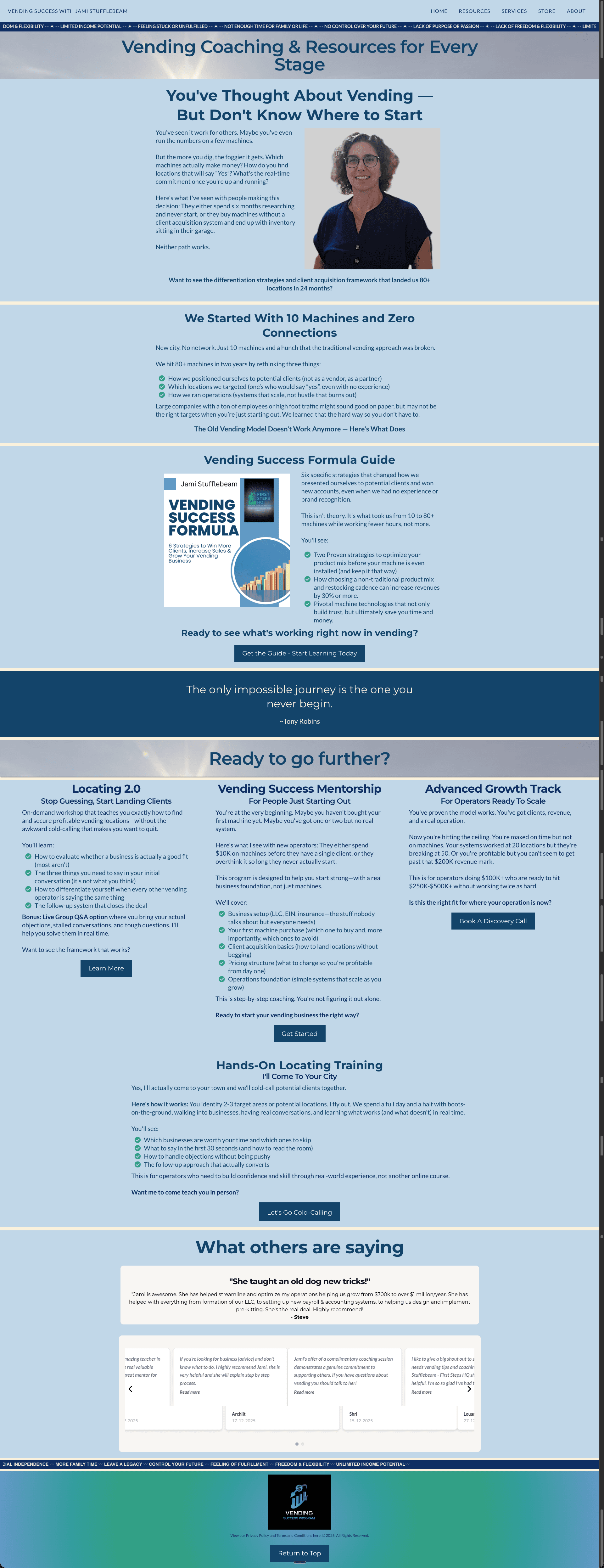
FirstStepsHQ is a vending machine business coaching company run by Jami Stufflebeam. She had built an engaged Facebook community and was driving consistent traffic to her website, but almost none of that traffic was converting. Visitors weren't buying her on-demand workshop. They weren't signing up for coaching. The website was getting clicks but not producing revenue.
I spent one week optimizing her website, setting up a CRM with automated pipelines, and building an email nurture sequence. The results were immediate: workshop sales went from zero to multiple per week, enough to pay for the entire engagement within weeks. Coaching conversions followed, and the nurture sequence started driving higher-ticket sales even from people who skipped the workshop entirely.
The Problem: Traffic Without Conversions
Jami had done the hard work of building an audience. Her Facebook presence was strong, and people were clicking through to her website regularly. But the site wasn't set up to convert that interest into action.
The problems were structural, not cosmetic:
SEO was nonexistent across 19 pages. Page titles, meta descriptions, heading structure, and on-page optimization were all missing or poorly configured. The site wasn't competing for any organic search terms, which meant all traffic depended on Jami's personal social media effort.
The mobile experience was broken. A significant portion of traffic from Facebook arrives on mobile devices. The site's mobile layout had usability problems that made it difficult for visitors to navigate service offerings, read content, or complete purchases.
No CRM or lead management system existed. When someone filled out a form, the inquiry went to email. There was no systematic way to track leads, follow up at the right time, or understand where prospects were in the buying process. Jami was managing everything manually.
No automated follow-up. Visitors who showed interest but didn't buy immediately had no reason to come back. There was no email sequence, no nurture campaign, and no way to build the relationship between first visit and purchase decision.
A subdomain was fragmenting the web presence. The store lived on a separate subdomain, splitting domain authority and creating a disjointed experience for visitors moving between the main site and the shop.
What I Did in One Week
The engagement was scoped at 16 hours over one week. I built everything directly into Ivorey, a GoHighLevel white-label platform, and sent Jami links as I finished each page so she could review them. Once I was done, I used Cap.so to record training videos so she could take ownership and maintain the site herself going forward.
SEO Optimization Across 19 Pages
Every page on the site got proper SEO treatment: optimized title tags, meta descriptions, heading hierarchy, and on-page content structure. I focused on terms that matched how Jami's target audience actually searches — people interested in starting or growing a vending machine business, not industry jargon.
Domain Consolidation
I moved the store content from its subdomain onto the root domain, consolidating the site's authority and creating a seamless experience for visitors navigating between content, services, and products.
Copy Revision
The existing copy was informative but wasn't structured to convert. I revised key pages to follow a clearer progression: identify the visitor's problem, present the relevant solution, and make the next step obvious. The goal was to make each page work harder without rewriting Jami's voice out of the content.
CRM Setup with Dual Pipelines
I built two sales pipelines in the CRM:
Workshop pipeline — converts prospects from Jami's free lead magnet to the paid on-demand workshop. This is the entry point for most new leads.
Coaching pipeline — converts paid workshop buyers into one-on-one coaching clients. Different buying decision, different timeline, different follow-up needs.
Having two pipelines means Jami can see exactly where every prospect stands across both revenue streams without mixing the two very different sales cycles.
Two Email Nurture Sequences
I designed and built two email nurture sequences, each targeting a different stage of the customer journey:
- Lead magnet to workshop — triggered when someone downloads the free resource, this sequence builds trust and makes the case for the paid on-demand workshop over a series of touchpoints.
- Workshop to coaching — triggered after a workshop purchase, this sequence deepens the relationship and introduces coaching as the logical next step for people who want hands-on guidance.
These sequences have helped Jami convert quite a few people who previously would have stopped at the free resource. Before, she was getting no sales from her funnel. The automated follow-up changed that entirely.
Results
The impact was fast and measurable:
Workshop sales went from zero to multiple per week. The same Facebook traffic that previously bounced off the site started converting into on-demand workshop purchases. The revenue from workshop sales alone covered the cost of the engagement within weeks.
Coaching conversions followed. Workshop buyers are now converting to one-on-one coaching at a meaningful rate, creating a natural upgrade path from the $49 entry point to higher-ticket services.
The nurture sequence is driving unexpected coaching sales. This was the pleasant surprise. People who don't buy the workshop are still entering the nurture sequence, and the emails are building enough trust that some are jumping directly to coaching — skipping the workshop entirely and going straight to the higher-ticket offer.
Vending machine store sales became an unexpected revenue driver. With the store consolidated onto the main domain and the CRM tracking the sales pipeline, vending machine product sales turned into a pleasant surprise for Jami – contributing more revenue than she'd anticipated from that side of the business.
The engagement has paid for itself many times over. The combination of workshop sales, coaching conversions, and product revenue has delivered a strong return on the $2,400 investment.
Why This Worked
Three things made this engagement effective:
The audience already existed. Jami had done the hardest part — building a community of people who trusted her expertise. The website just wasn't capturing that trust and converting it into revenue. Fixing the conversion infrastructure was the highest-leverage thing we could do.
Small business doesn't mean small thinking. This engagement used the same strategic approach I bring to enterprise projects: diagnose the real problems, prioritize by impact, and implement systems that work without constant manual intervention. A CRM with automated pipelines isn't just for large sales teams. A nurture sequence isn't just for SaaS companies. These are tools that work at any scale when implemented correctly.
Training created ownership. I recorded training videos using Cap.so so Jami could take full ownership of the systems. She came out of the engagement able to maintain and extend everything we built. She's not dependent on me for day-to-day operations. The systems are hers.
Frequently Asked Questions
How do you optimize a website for conversions in just one week?
The key is focusing on the highest-impact changes rather than trying to perfect everything. SEO fundamentals, clear conversion paths, and a working CRM pipeline create the infrastructure for revenue. You don't need a complete redesign — you need the right structural changes to turn existing traffic into customers.
What CRM platform was used for this project?
The site runs on Ivorey, a GoHighLevel white-label platform. GoHighLevel provides CRM, pipeline management, email automation, and website hosting in a single platform, which is well-suited for small businesses that need these capabilities without managing multiple tools.
Does an email nurture sequence work for small coaching businesses?
Yes, and this project is a good example of why. The nurture sequence built enough trust that some subscribers skipped the entry-level offer entirely and went straight to higher-ticket coaching. Email nurture works for any business where the buying decision benefits from multiple touchpoints and relationship-building.
Does a small business website need Google Analytics?
Not necessarily. For Jami, what mattered wasn't how many people visited or bounced – it was whether workshops converted to coaching and whether her vending machine store was making sales. The CRM pipeline gave her that visibility directly. Analytics can be valuable, but they also mean either investing significant detail into a privacy policy or paying for a privacy-friendly alternative. For a small business, the question is whether the data will actually change your decisions. If your CRM already tells you what's converting, analytics might not be worth the complexity.
How much does a project like this cost?
This engagement was scoped at 16 hours over one week for $2,400. The exact scope and cost depend on the complexity of the business, the state of existing systems, and how many revenue streams need to be addressed. The ROI math is usually straightforward — if the systems generate more revenue than the engagement cost, it's a good investment. In this case, that threshold was crossed within weeks.
Related Case Studies
- Career as a Platform: Rescuing a Stalled Team at Stride — Another engagement where the fix was structural, not cosmetic
- University Help Desk Website Redesign — A similar challenge of turning an existing audience's visits into productive outcomes