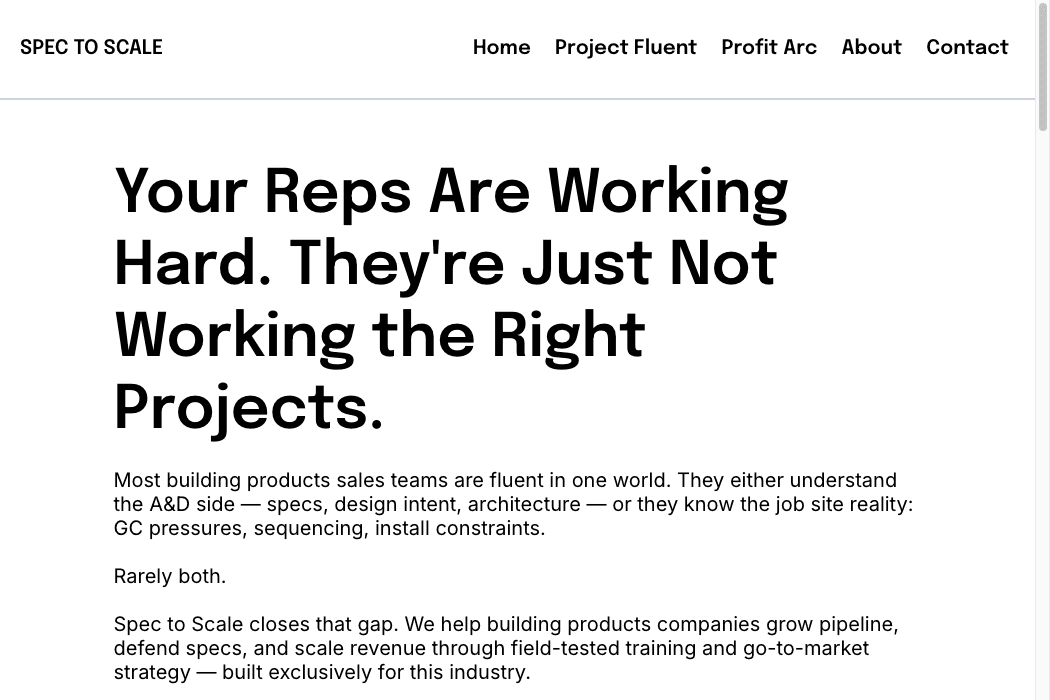
Spec to Scale is a revenue system design and sales enablement firm for early-stage building-product companies, founded by Carolina Baffigo. When she came to me, her business was split across three separate websites — projectfluent.co for her sales training program, profitarc.co for her go-to-market consulting, and carolinabaffigo.com as a personal site. Each represented a real service line, but the fragmented web presence made it harder for prospects to understand what Spec to Scale actually offered and harder for Carolina to present a unified brand.
I built spectoscale.com from scratch: a clean, professional site that brings both service lines under one roof, with conversion infrastructure — forms, email automations, contact list migrations — that didn't exist before.
The Situation: Three Sites, No Conversion Path
Carolina had done the foundational work of developing two distinct service lines for building-product companies:
Project Fluent — sales training for building products reps. Teaching the people who sell construction materials, fixtures, and building systems how to sell more effectively.
Profit Arc — go-to-market consulting for manufacturers. Helping founder-led building-product companies figure out their revenue strategy, typically in the $1-5M range, often seed to Series A.
Both services had their own websites, and Carolina had a personal site as well. The problem wasn't that the sites were bad — it's that having three of them created confusion about what the business actually was. A prospect who found Project Fluent had no easy path to learning about Profit Arc, and vice versa. There was no unified brand telling the story of how these services fit together.
Beyond the fragmentation, there was no conversion infrastructure. No automated follow-up after someone booked a discovery call. No email nurture sequences. No assessment funnel. Two separate email lists (~300 contacts on one, ~150 on the other) were sitting in Kit (formerly ConvertKit) with no automations attached. Carolina was doing everything manually, which works until it doesn't.
What I Built
The Website: spectoscale.com
I designed the site in Figma Make and built it in Ivorey, a platform built on GoHighLevel. The design is intentionally clean — black and white, professional, no visual clutter. The site has seven core pages:
- Homepage — positions Spec to Scale as a unified brand and routes visitors to the right service line
- Project Fluent — dedicated page for the sales training offering
- Profit Arc — dedicated page for the go-to-market consulting offering
- About — Carolina's background and credibility
- Contact / Book a Call — discovery call booking with an intake form
- Blog — content hub
- Assessment page — a landing page for a diagnostic tool that feeds into the sales funnel
Each page got SEO meta tags, proper heading structure, and social sharing image cards.
Domain Redirects
I set up redirects from projectfluent.co and profitarc.co to the appropriate pages on spectoscale.com. Anyone with an old bookmark or who finds an old link lands on the right page on the new site. This also begins consolidating whatever domain authority the previous sites had built.
Email List Migration
Carolina had two email lists in Kit (ConvertKit): approximately 300 contacts on a spiritual/personal list and approximately 150 on a business-focused list. I migrated both lists into Ivorey so that all contacts live in one system alongside the website, forms, and automations.
This is the kind of task that sounds simple but matters a lot. Having contacts in a separate email platform from your website and CRM means manual work every time someone fills out a form, every time you want to send a targeted email, every time you want to understand which contacts are engaging with what. Consolidating everything into one platform eliminates that friction.
Email Nurture Sequences
I built two automated email sequences:
Post-discovery-call-booking sequence — triggered when someone books a call through the site. This sequence confirms the booking, sets expectations for the conversation, and provides context that makes the call more productive for both parties.
Post-assessment follow-up sequence — triggered when someone completes the assessment. This sequence delivers their results and builds the case for the relevant service offering based on what the assessment surfaced.
Forms and Conversion Points
The site includes a discovery call booking form, a general contact form, and email sign-up pages. Each form feeds into the appropriate automation. Nothing goes to a generic inbox and waits for a manual response.
Copywriting
Beyond the website copy itself, I wrote the email sequences and the assessment landing page copy. The emphasis was on clarity — what does Spec to Scale do, who is it for, and what should the visitor do next. Building-product companies at the $1-5M stage don't have time for vague messaging.
The Approach
The project moved quickly because the scope was clear and the decisions were made upfront.
Before building anything, I reviewed all three of Carolina's existing sites to understand what was working, what the services actually were, and how they related to each other. The design phase in Figma Make happened before any pages were built in Ivorey, which meant we weren't making design decisions inside the CMS — a process that always leads to compromises.
The black-and-white aesthetic was a deliberate choice. Carolina's market — founder-led building-product companies — responds to professionalism and clarity, not visual flair. The design says "serious consultancy," which is what Spec to Scale is.
Building in Ivorey (GoHighLevel) meant the website, forms, email automations, and contact management all live in one platform. There's no duct tape connecting a WordPress site to Mailchimp to Calendly to a spreadsheet. When someone fills out a form, the automation fires, the contact is created, and the follow-up begins — all in the same system.
What Was Delivered
To be straightforward: this project was completed in March 2026, so there aren't long-term results to report yet. What I can describe is what was delivered and why it matters.
A unified web presence. Three separate sites consolidated into one professional site that tells a coherent story about what Spec to Scale does and who it serves. Visitors can find both service lines and understand how they relate.
Domain redirects preserving existing traffic. Anyone who had bookmarked or linked to projectfluent.co or profitarc.co lands on the correct page at spectoscale.com.
Automated conversion infrastructure. Forms, email sequences, and automations that didn't exist before. Carolina is no longer dependent on manual follow-up for every inquiry.
Consolidated contact lists. ~450 contacts migrated from Kit into Ivorey, ready for targeted communication through the same platform that hosts the website.
SEO foundation. Every page has proper meta tags, heading structure, and social sharing cards. The site is ready to compete for organic traffic in its niche.
Complete platform ownership. Carolina has everything in one system she controls. No dependencies on multiple platforms, no integration points that can break, no monthly bills for three separate tools doing what one can handle.
The engagement delivered a complete web presence and conversion system. Whether it delivers ROI depends on what Carolina does with it — but the infrastructure is there, which is more than could be said before.
Frequently Asked Questions
Why consolidate multiple websites into one instead of keeping separate brands?
When the services share a target audience and a founder, separate sites create confusion rather than clarity. A building-products company looking for sales training and go-to-market consulting benefits from seeing both options in one place. Separate sites also fragment SEO authority, complicate analytics, and multiply maintenance work. Consolidation makes the business easier to understand, easier to find, and easier to run.
What is Ivorey, and why was it chosen for this project?
Ivorey is a white-label platform built on GoHighLevel. It provides website hosting, CRM, form building, email automation, and contact management in a single platform. For a small consultancy like Spec to Scale, having everything in one system eliminates the complexity and cost of connecting multiple tools. It's particularly well-suited for service businesses that need conversion infrastructure without enterprise-level overhead.
What makes a website consolidation project go smoothly?
Clear scope and upfront decisions. When branding, service positioning, and page structure are resolved before building starts, the build itself moves fast. Projects that drag out typically do so because of unresolved questions about what the business is, scope creep into features that don't serve the immediate business need, or design-by-committee dynamics.
What happens to SEO when you redirect old domains to a new site?
Properly configured redirects (301 redirects) pass most of the old domain's SEO value to the new URL. Visitors and search engines both land on the right page. The consolidation typically helps SEO over time because all content and authority accumulate on one domain instead of being spread across several. The transition period may show temporary fluctuations in search rankings, but the long-term trajectory favors consolidation.
Related Case Studies
- Turning Facebook Traffic into Paying Customers for FirstStepsHQ — A similar engagement building conversion infrastructure for a small business on GoHighLevel, with measurable revenue results