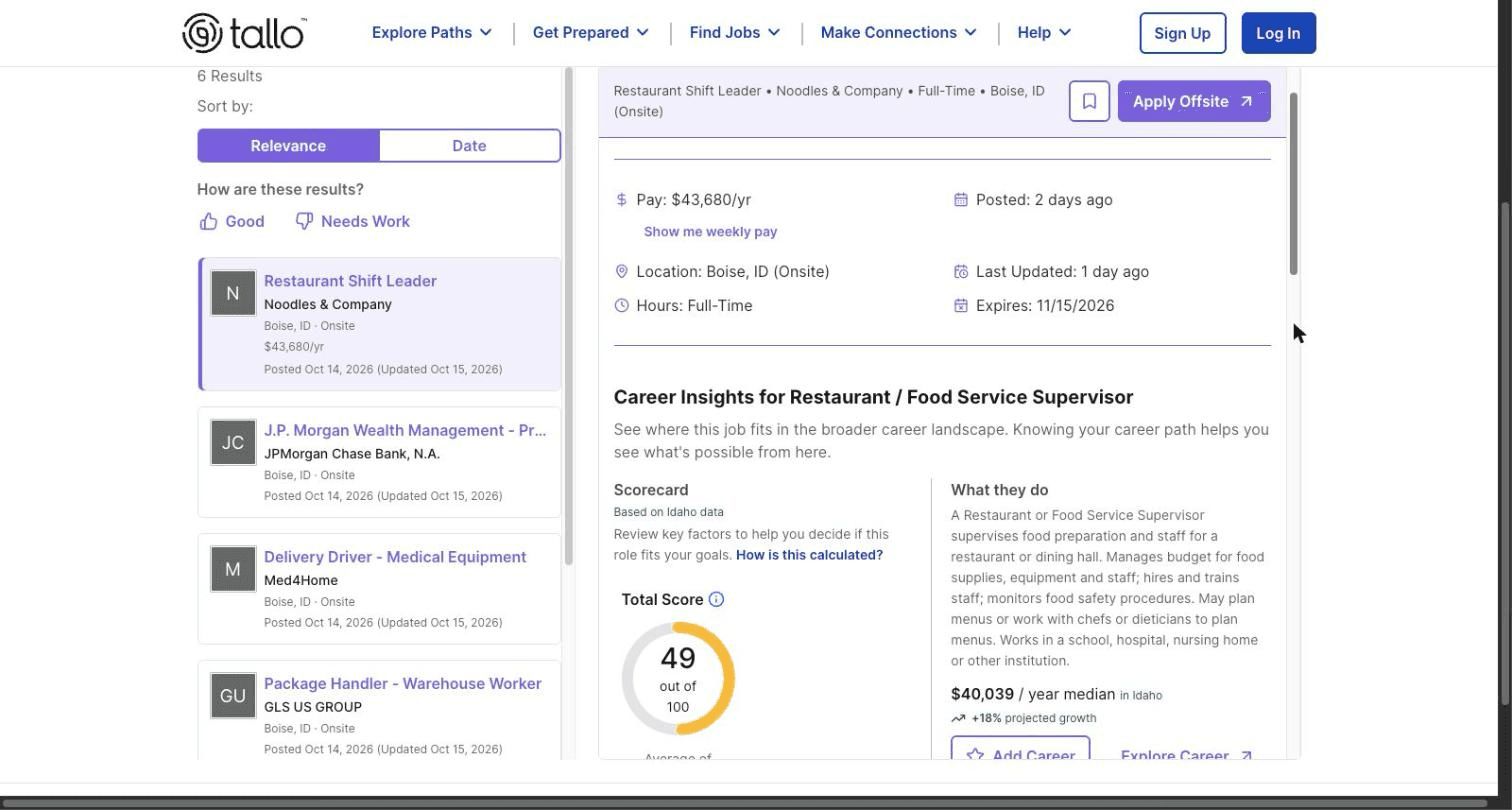
On March 3, 2026, Tallo's job pages moved out of WordPress and into the product. In the months after, a larger share of a much larger audience clicked apply, and far more visitors went on to explore the rest of Tallo instead of leaving after one page.
The part of this story I like best is that the migration wasn't my idea. It was already underway when I arrived, and it was stuck.
The Job Page Was Where Career Starters Actually Were
Tallo is a career platform owned by Stride, built to connect young people with jobs, scholarships, and training. I came in to help Tallo figure out how to serve career starters – 18-to-20-year-olds who aren't in college and are trying to land their first real job – and that strategy work turned into leading product for the team building for them.
Career starters were finding Tallo through Google and landing on a job page. But those pages lived in WordPress, separate from the actual product. A visitor arrived, read a job description they could have found on Indeed, and left, and almost none of them came back. For most career starters, that single static page was Tallo.
The strategy work kept pointing at the same conclusion. If the job page is where career starters are, the job page is where the product needs to be.
The Migration Was Tallo's Decision, Not Mine
Tallo knew this before I said it. A project to move the job pages into the product was already in flight when I joined. I want to be clear about that, because consultants have a habit of arriving after the hard decisions are made and taking credit for them, and this decision belonged to Tallo.
The project had stalled, though. Every conversation surfaced one more thing the new page should do before launch, and the finish line kept sliding to make room for it. The team was working hard, and the work just wasn't converging.
This is one of the most common failure patterns I see in product organizations, and it's rarely about effort or talent. It's about nobody holding the authority – or feeling like they hold it – to say "not in version one."
Stepping In as Project Manager
I'm a product strategist, and Tallo didn't bring me in to run a migration. But the fastest way to create value was to get this project over the line, so alongside designing features, I stepped in as the project manager.
We cut launch scope to what the page needed on day one and moved everything else to the roadmap, where it could be sequenced on its merits instead of jammed into v1. Then we set a cutover date and held it. Holding it is the part that matters, because a date you don't hold is just a wish with a calendar entry.
The new job pages went live on March 3.
Owning the Page Made the Features Possible
A migration by itself is plumbing. Moving the same job description onto a different tech stack gives nobody a reason to care. The point of owning the page in the product was that we could now build things WordPress never could.
The first was a Job Scorecard that rated each job on pay growth and job security, with a plain-language read of each score and a link explaining exactly how it was calculated. For an audience with finely tuned scam detectors, showing the math mattered as much as the math itself. The scorecard has since grown into the Career Scorecard, and job recommendations built on the same data now sit right on the page. I wrote about that work in Building a Career Scorecard and Job Recommendations for Career Starters.
None of it would have had a place to live if the migration were still stuck in its scope conversation.
What Changed After the Rebuild
We compared the old WordPress pages with the rebuilt product pages over the 90 days after cutover, and every number we cared about moved the right way. Traffic grew substantially. Apply clicks grew faster than traffic, so the apply rate went up, too. And clicks into the rest of Tallo – the thing the old pages almost never produced – grew even faster than apply clicks.
I don't give the scorecard credit for all of that. The rebuild changed design, speed, page structure, and features at the same time, and more traffic brings its own dynamics. That's why we watched rates and not just raw clicks. A bigger share of a bigger audience chose to act, and the job page stopped being a dead end and started being a doorway into Tallo.
What I'd Tell a Team With a Stalled Migration
The team didn't need more effort, better engineers, or a new plan. They needed a smaller launch, a home for everything that got cut, a date, and someone accountable for holding all three. If you can't name the person who's allowed to say "later," that's probably why the date keeps moving.
FAQ: Stalled Migrations and Job Page Rebuilds
Why do replatforming projects stall before they ship?
Scope creep, mostly. Every stakeholder conversation adds one more requirement to v1, and nobody holds the authority to say "later." At Tallo, engineering was capable the whole time, so it wasn't a technology problem. It was a decision-making problem. The fix was unglamorous: a smaller launch scope, a roadmap for everything cut, a cutover date, and someone accountable for holding all of it.
Did the Job Scorecard cause the increase in apply clicks?
Not by itself, and I'd be skeptical of anyone claiming one feature drove a result like that. The rebuild changed the whole page at once, so the lift belongs to the project. What I can say is that the apply rate went up while traffic grew, which means the new page converted a larger share of a larger audience, and the scorecard was one of the clearest differences between the old page and the new one.
Why move job pages out of WordPress at all?
On WordPress, the job page was a dead end, separate from the product, so nothing a visitor did there connected to an account, a goal, or a next step. Moving it into the product meant the page could carry product features like scores, recommendations, and personalization, and give people a reason to sign in and come back.
Related Case Studies
- Building a Career Scorecard and Job Recommendations for Career Starters at Tallo – the features the rebuilt job page made possible.
- Defining Tallo's Resume Builder – research and a phased roadmap for another career starter feature.
- Designing a Soft Gate for Email Verification at Tallo – another scope call, this time on where verification belonged.
- Rescuing a Stalled 80-Person Product Team at Stride – Tallo's parent company, and a similar pattern: a capable team that needed decision-making repair more than more effort.