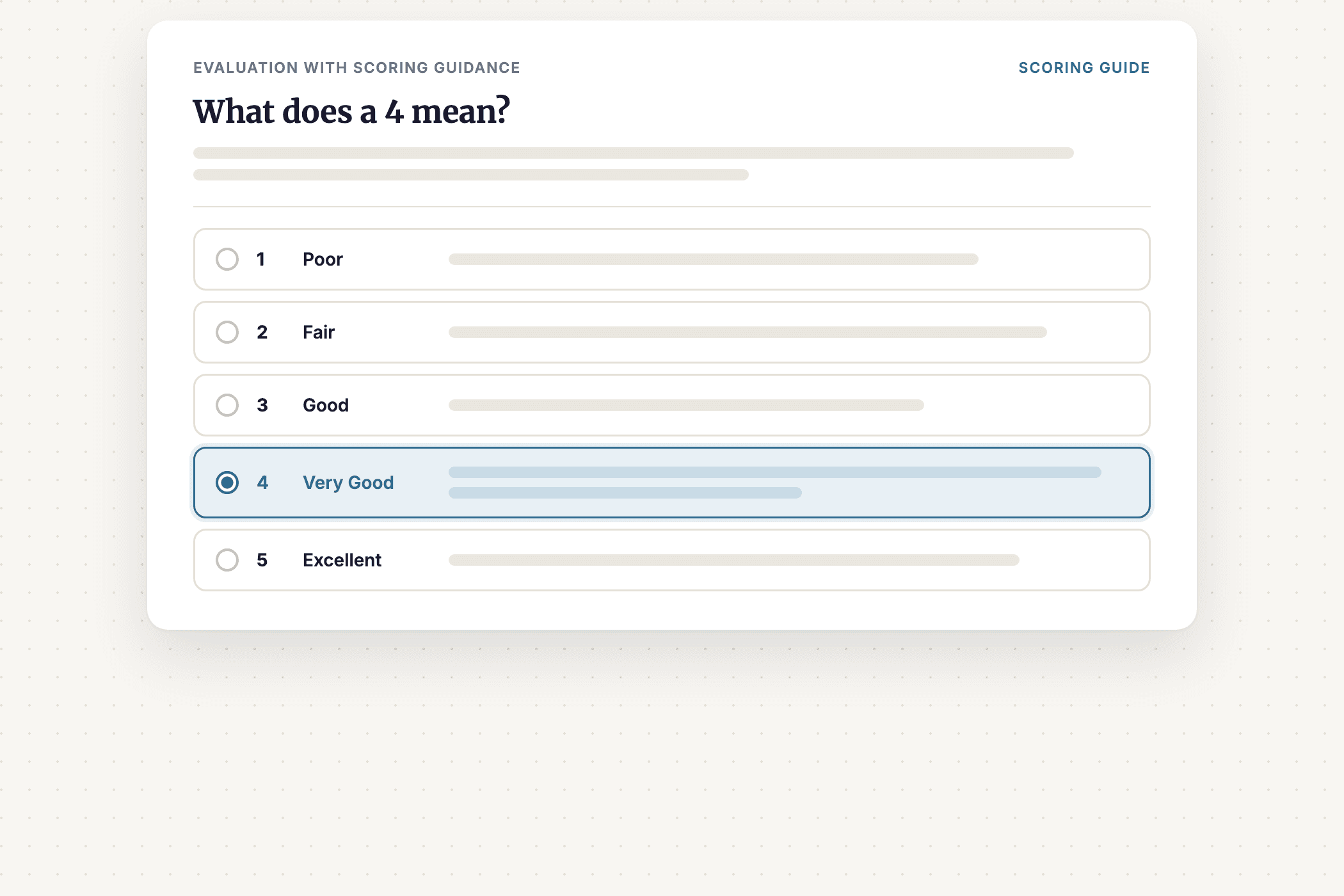
The Community Foundation of the Ozarks asks volunteers to score grant applications from 1 to 5, question by question. Until this summer, the forms didn't say what a 3 was, or a 5. Two reviewers could read the same application, both land on 4, and mean completely different things by it, and nobody would know until the committee met and the averages didn't make sense.
Between June and September 2026 I wrote scoring guidance for 21 of CFO's grant programs: 525 short descriptions of what an application at each point on the scale actually contains. Two of the programs didn't have an evaluation form yet, so I designed those question sets from scratch. And one is scored by middle- and high-school students, so its rubric got rewritten top to bottom for them.
I did this as a volunteer. I sit on CFO's Grant Advisory Committee, and none of it was billed.
The Problem
The reviewers are volunteers, many of them new to it, and the forms gave them a question and five empty boxes. Earlier in the year the committee agreed the forms needed attention, and by May it had settled on an approach other community foundations use: a short description next to every point on the scale, so a reviewer knows what each score means.
By then I'd built a system for exactly this kind of document work, so I volunteered to write the rubrics.
What I Did
Each program went the same way. I read the evaluation form against the application it scores, because a reviewer can only judge what the application asks for, and every description needed to point at something they could actually find on the page. Each question also got a short note telling the reviewer where in the application to look.
Then I wrote a short frame for the program – what it funds, who decides, and so what a 5 should mean. A rubric for a small local grant round and one for a regional fund shouldn't reward the same things, so nothing could be copy-pasted between programs.
I kept CFO's question wording exactly as it appears on each form, even where I'd have written it differently. Reviewers know those questions, staff have them in the grant portal, and a rubric that quietly rewrites the question it's supposed to guide is a new form pretending to be the old one. Where I thought a question was missing, I put a proposal in its own marked section that CFO could adopt or ignore.
Every rubric also opens with a few reminders for the reviewer: score what's on the page rather than what you already know about the organization, don't mark down a new program just for being new, and stay fair even when a cause matters to you personally. And where a form had a structural gap, I flagged it instead of fixing it without notice, because the forms are CFO's.
Writing for Student Grantmakers
One of the programs is youth-led grantmaking. Middle- and high-school students read the applications and decide which projects get funded, so the students are the committee.
The adult rubrics are written at roughly an eighth-grade reading level, which works for a volunteer committee and isn't quite right for a seventh grader. Shorter descriptions wouldn't have fixed it, either, because the hardest language on the page wasn't in the descriptions. It was in the scale and instructions every rubric shares, which leaned on assessment words a fourteen-year-old has no reason to know.
So the student version rewrites all of it. Abstract terms became things a student can picture: instead of asking about measurable outcomes, it asks how the organization will know the project worked. The descriptions moved into second person, asking what the reviewer can see and picture rather than what the application demonstrates. And the reminders give permission before they give instructions – everyone has favorite causes, and that's fine, but score the application anyway.
Two pieces have no adult equivalent. The first tells students plainly that they're the grantmakers and their scores decide where the money goes, because an adult on a committee knows the number counts and a student reading their first application may not believe it. The second gives them permission to score low. Students reviewing organizations that are plainly trying to help kids are going to want to be kind, and a stack of 5s tells the group nothing about which project to fund.
Rungs a Reviewer Can Check
The first round of rubrics went out in June and was well received. When the rest of the forms arrived in August, I reread my own early work, and some of it didn't hold up.
Too many of my first descriptions climbed on adjectives. A partnership went from reasonable to strong to deep, and reading it again, I couldn't say how a volunteer was supposed to tell "strong" from "deep" while holding a list of partner names. So I rebuilt those ladders around things a reviewer can find in the application: partners named, then their roles described, then evidence they're contributing rather than just endorsing.
That became a check I ran on every rubric. For each step from one point to the next, I had to name what a reviewer could point to in the application. If the answer was an adjective, an intensifier, or the question restated, the step failed and got rewritten. All 21 rubrics went through it before the final delivery in September, including the seven already in use.
The other change across the whole set started with a catch from CFO staff: one rubric stated an award size that was wrong. When I looked at why, the fix wasn't a better number. Award sizes vary a lot from round to round, so any figure was going to be wrong somewhere eventually. Now no rubric contains a dollar amount, and the amounts stay in the program guidelines, where staff can change them without touching the rubrics.
Handing Over the System
Most of the drafting ran through a system I built with Claude. It reads a program's form and application, applies a house style, and drafts each rubric into my notes, where I review and revise it before anything goes to CFO. CFO knew that from the start.
The system is what made 21 programs possible for one volunteer. It didn't decide what a program was for, which gaps to flag, or when a question was past saving with better wording, and the rung check exists because my own first round leaned on adjectives. The judgment stayed with me.
With the final batch, I included the method itself: the house style, the notes on each program, and what I'd learned reading CFO's forms. If CFO ever wants to build or revise a rubric without me, everything it needs is in that folder.
Results
The committee was glad to have them. The August committee minutes record the committee's praise for the updated rubric wording, and several members wrote to say the rubrics added structure and consistency to how CFO evaluates applications. More than one singled out the reminders about personal bias.
CFO put them in front of reviewers. Staff shared the new guidance with the committee ahead of the August meeting, then sent every remaining program in one batch so the whole set could be done the same way.
CFO doesn't need me to keep going. With the method handed over, the next program, or the next revision, can be done in-house.
What Rubric Work Actually Requires
Most of the effort isn't writing. It's reading the application closely enough to know what a reviewer will have in their hands when they're deciding between a 3 and a 4, and then describing that, instead of describing how good the answer feels. Adjectives feel like guidance while you're writing them. They stop feeling like guidance the moment someone tries to score with them, and I had to see that in my own first drafts before I could fix it.
Writing for a different audience took more than smaller words. The student rubric needed pieces the adult one didn't have, because student reviewers struggle in different ways: they doubt their score matters, and they want to be kind. A plainer version of the adult rubric wouldn't have addressed either one.
And the forms belong to the people who run the program. I could see places where I'd have asked a different question, and I put those in a separate section and left the decision with CFO.
Frequently Asked Questions
Did you change CFO's evaluation questions?
No. Every rubric uses the form's wording exactly as written. Where I thought a question was missing or a form was too thin to score fairly, I proposed new questions in a separate, clearly marked section, and CFO decides whether to use them.
How long did it take?
About four months from the May committee meeting to the final delivery, in three rounds. The first rubrics went out in June, more in July, and all 21 revised and complete in September, including two designed from scratch for new grant rounds that didn't have forms yet.
Could this work for another foundation?
The method transfers. The descriptions don't, because each program funds different things and a 5 means something different in each. The same approach would work for any review process where volunteers score against a scale.
Related Case Studies
- Generosity Collective: A Newsletter System for a Volunteer Giving Circle – Another volunteer project for the Community Foundation of the Ozarks, built around the same idea of matching the writing to who's reading it.
- Documentation Migration and Unification for Adaptavist – Templates and a style guide that made 25+ products' documentation consistent, which is a rubric problem at a different scale.
- Banner ERP Rollout: 700-Article Knowledge Base Built – Writing instructions for people who have to act on them under time pressure.