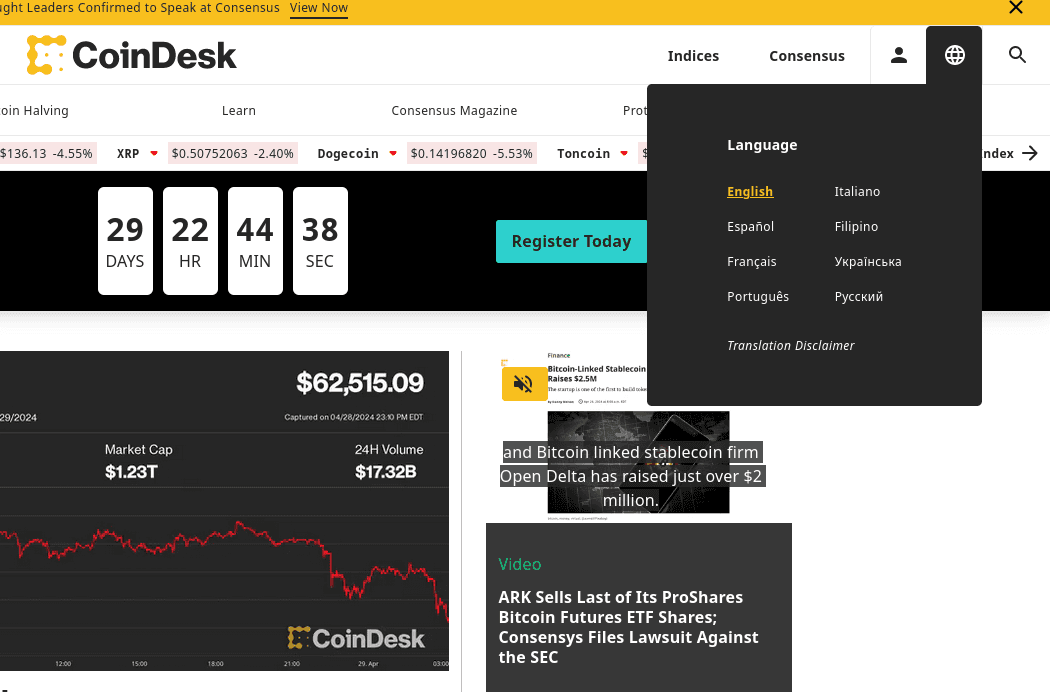
Every new language we launched grew traffic 70-120% week over week. That's not a typo, and it wasn't a fluke. When I built CoinDesk's machine translation system in 2023, each language addition created a compounding growth curve that proved something I'd suspected: the global appetite for crypto news in native languages was massively underserved.
The system used Google Cloud Translate for Latinate languages, DeepL for Eastern European and Asian languages, and custom-built cryptocurrency glossaries to handle terminology that no general-purpose translation engine gets right out of the box. But the technical architecture was only part of the story. The real insight was in how we chose which languages to launch and in what order.
Why CoinDesk Needed a Machine Translation Strategy for Crypto News
CoinDesk in 2023 was an English-first publication serving a global audience. Cryptocurrency is, by its nature, borderless. Someone trading Bitcoin in Seoul has the same need for breaking news as someone in San Francisco. But CoinDesk's content was only accessible to English speakers, which meant we were leaving enormous audiences on the table.
The case for translation was obvious. The question was how to do it at the speed and scale a news organization requires. CoinDesk publishes dozens of articles per day. Breaking news can't wait for human translators. By the time a translator finishes a piece about a market crash, the market has already recovered (or crashed further). Machine translation was the only viable approach for a news operation.
But machine translation for crypto content has a specific and serious problem: terminology. Many crypto terms are used in English across other languages – communities just use the English term. The problem was that general-purpose translation engines would sometimes translate these terms into local words that meant something entirely different. "Crypto" itself is a good example – it would get translated into something meaning "to encrypt something." We also had to pay attention to sentence structure, because when referring to cryptocurrency terms, sometimes the term should be placed in a different part of the sentence or even the paragraph depending on the language. A naive implementation would produce translations that were technically correct at the sentence level but incomprehensible to anyone in the local crypto community.
Analyzing Cryptocurrency Transaction Data to Prioritize Target Languages
Most companies prioritize translation languages based on GDP, internet penetration, or general market size. I took a different approach built on two data sources. First, I looked at the countries with the top cryptocurrency holdings – populations that were holding the most cryptocurrency. Second, I looked at countries with the most cryptocurrency transactions, because there might be a lot of transactions happening but less holding. By bringing these two datasets together, along with Google and SimilarWeb data on user website engagement for both CoinDesk and other news outlets, I developed a prioritized list.
This data-driven prioritization produced a different ranking than a generic "biggest internet markets" list would have. Some countries with enormous general internet populations had relatively small crypto communities. Other countries with smaller populations had disproportionately active trading volumes and community engagement.
I won't disclose the specific priority order since that was proprietary competitive intelligence for CoinDesk. But the methodology mattered: rather than guessing which languages would perform best, we let actual market data tell us where the demand was. This meant every language we launched was pre-validated by real activity.
Building a Dual Translation Engine: Google Cloud Translate and DeepL
Not all machine translation engines perform equally across all language families. This is something that becomes clear quickly if you test outputs rather than just reading vendor marketing materials.
Through systematic evaluation, I found that Google Cloud Translate performed better for Latinate (Romance) languages – Spanish, Portuguese, French, Italian. Google's training data for these language pairs is enormous, and the structural similarities between Romance languages and English mean the outputs are generally natural and accurate.
For Eastern European and Asian languages, DeepL consistently produced superior results. Languages like Polish, Czech, Japanese, and Korean have grammatical structures that diverge significantly from English, and DeepL's neural translation models handled these divergences more gracefully than Google's offering at the time.
The architecture I built routed content through the appropriate engine based on target language. This wasn't a complex decision tree. It was a straightforward mapping: language X goes to engine Y. But that simple routing decision, informed by actual output quality testing, made a meaningful difference in the readability of the translated content.
These translation systems are continually leapfrogging each other. Even during the time we were building this, there were changes in which system was best. So we built middleware that let us swap the translation engine on a per-language basis. If we did some testing and realized that DeepL was suddenly doing better for Vietnamese, we could make that change in about five minutes. If we wanted to add OpenAI as a translator, we could do that too. This middleware made it trivial to switch translation systems so we could ensure our translations were always as accurate as possible. Someone reading this today might scoff and say one system or another doesn't do certain languages well – and they might be right today. We chose the best performing at the time, but we knew that would change, so we planned and built accordingly.
Both engines were accessed via API, integrated into CoinDesk's content management system. When an editor published an English article, translated versions were generated automatically and published to language-specific sections of the site. The latency from English publication to translated publication was minutes, not hours or days. For a news operation, that speed was essential.
Developing Custom Cryptocurrency Glossaries for Translation Accuracy
The glossary work was the most labor-intensive part of the project and also the most important. Machine translation engines allow you to specify custom glossaries that override default translations for specific terms. I built comprehensive glossaries for every target language covering cryptocurrency-specific terminology.
This required research into how each language's crypto community actually talks about these concepts. In some cases, communities had adopted English loanwords (many languages use "blockchain" directly). In others, they'd developed native terminology that had become standard. Using the wrong term, even if it was a technically accurate translation, would mark the content as "not from here" and undermine reader trust.
I spoke with several different translation agencies, selected one, and hired them to do the translation work. We put together a spreadsheet of terms and had them translate those terms and provide advice to us across all the different languages we were going to target. This wasn't a one-time effort. As we found new terminology, I would build a new spreadsheet and go back to the agency to have them translate the new terms. New terminology emerges constantly in crypto, and glossaries needed regular updates.
Some examples of why this mattered:
- "Mining" in the cryptocurrency sense needs different handling than the literal translation of extracting minerals from the ground. Many languages have adopted the English term, but not all.
- "Wallet" in crypto doesn't mean a physical billfold. Some languages use a distinct term for digital/crypto wallets versus physical ones.
- "Gas" (Ethereum transaction fees) is almost universally untranslatable by general-purpose engines. Without glossary intervention, readers get the chemical substance, not the blockchain concept.
- DeFi protocol names (Uniswap, Aave, Compound) should never be translated. But translation engines sometimes try to translate proper nouns that look like common words.
The glossaries grew to hundreds of entries per language. They were, in many ways, the product's core intellectual property.
Week-Over-Week Traffic Growth of 70-120% Per New Language Launch
The results were striking. Each new language we launched drove 70-120% week-over-week traffic growth in that language segment. This wasn't a one-time spike from novelty. The growth compounded as search engines indexed the translated content, as readers bookmarked CoinDesk in their native language, and as social sharing within non-English crypto communities amplified discovery.
Several factors drove this performance:
Reader preference validated. We were actually late to the game – other major crypto news outlets were already translating, and that was part of the signal to us that we needed to start. The big increases in traffic demonstrated that there were people who wanted to read our content and preferred CoinDesk over the competition. We just weren't providing it in their language. By starting to translate, those readers were telling us they preferred CoinDesk – they'd just been waiting for us to meet them where they were.
SEO compounding. Each translated article was a new indexed page targeting keywords in that language. CoinDesk's domain authority carried over, meaning translated pages ranked well relatively quickly. Over weeks and months, the translated content library created a self-reinforcing SEO flywheel.
Community engagement. Crypto communities are tight-knit and organized around shared information. When a credible news source starts publishing in a community's language, word spreads fast through Telegram groups, Discord servers, and local social media.
Publishing velocity. Because the system was automated, we could translate the full daily output, not just selected highlights. This meant readers in any language got the same comprehensive coverage as English readers. That completeness built trust and habitual readership.
What Global Content Strategy Requires Beyond Literal Translation
The biggest lesson from this project wasn't technical. It was strategic. Global expansion in content requires understanding community engagement patterns, not just language differences.
For example, some markets consumed crypto news primarily through Telegram. Others relied on Twitter (now X). Others used local platforms that don't exist in the English-speaking world. The translation system got content into the right language, but distribution required understanding how each community actually consumed information.
We also learned that translation quality thresholds vary by content type. Breaking market news with simple factual sentences translated well with minimal glossary intervention. Long-form analysis pieces with nuanced arguments needed more careful glossary coverage and occasionally required light human review. Opinion pieces were the hardest, because tone and voice don't translate the way facts do.
I don't want to overstate the human review component. The vast majority of content went straight from automated translation to publication. But we built something interesting into the CMS: the option to override a translation. This was a tricky technical challenge because sometimes the English source article would be updated and we'd want those updates translated to ensure accuracy. Other times, a human had reviewed and improved the translation, and we wouldn't want their improvements overwritten.
We built a system that let people flag whether specific fields in the CMS should be re-translated or not. We broke this down to a granular level – if somebody changed one or two words in a paragraph, only that paragraph would be re-translated, not the entire story. This reduced token usage and saved on cost. If someone made a manual translation improvement to one section, that section could be locked while the rest of the article stayed auto-updated. We built a dashboard that flagged articles where a source update affected content that had manual translation overrides, so a reviewer could check whether the manual translations needed updating too.
Having this system, and knowing which content types were most likely to produce edge cases, kept quality high enough that readers trusted the output.
Technical Architecture Decisions for News Translation at Scale
A few technical decisions that proved important:
Separate URL structures per language rather than dynamic translation. Each language got its own URL path (/es/, /pt/, /ja/, etc.). This was essential for SEO. Search engines need crawlable, static URLs to index content properly. Dynamic, client-side translation would have been invisible to search engines and killed the SEO compounding effect.
Glossary versioning. As glossaries evolved, we needed to know which version was used for any given article. This let us retroactively update older translations when a glossary entry changed, and it gave us an audit trail for quality issues.
Fallback handling. When the primary translation engine had an outage or returned errors, the system fell back to the secondary engine rather than failing silently. Better to publish a slightly lower-quality translation on time than a perfect one three hours late.
Monitoring translation output quality. We set up automated checks for common failure modes: untranslated proper nouns, suspiciously short outputs (indicating truncation), and glossary misses. These didn't catch every issue, but they caught the catastrophic ones before they reached readers.
FAQ: Machine Translation for News and Content Websites
Is machine translation good enough for news content without human review?
For factual, straightforward news content, yes. Modern neural machine translation, especially with custom glossaries for domain-specific terminology, produces output that's readable and accurate. For opinion pieces, nuanced analysis, or content with complex sentence structures, quality drops and some human review helps. The key is building glossaries specific to your domain and testing output quality systematically rather than assuming all content types translate equally well.
How do you choose between Google Cloud Translate and DeepL for a translation project?
Test both with your actual content in your target languages. Marketing claims and benchmark scores don't tell the full story. In my experience at CoinDesk in 2023, Google performed better for Romance languages (Spanish, Portuguese, French) while DeepL produced more natural output for Eastern European and Asian languages. But this can vary by domain and content type. Run blind quality evaluations with native speakers before committing to an engine for any given language.
What's the ROI timeline for adding machine translation to a content website?
We saw 70-120% week-over-week growth per language, which means the traffic impact is visible almost immediately. But the real ROI builds over months as translated content gets indexed by search engines and you build a library of translated pages. The costs are relatively low: API translation fees are pennies per article, and the main investment is in glossary development and system integration. For most content-heavy websites with international audiences, the payback period is measured in weeks, not months.
Related Case Studies
- Rescuing a Stalled 80-Person Product Team at Stride – Another case where data-driven decisions and systematic process design drove rapid results, this time in product leadership rather than content strategy.
- Enterprise Agile Transformation Piloted for 20,000 Consultants at a Big Four Firm – A case study in scaling systems and processes across a global organization, paralleling the multi-market challenges of the CoinDesk translation project.